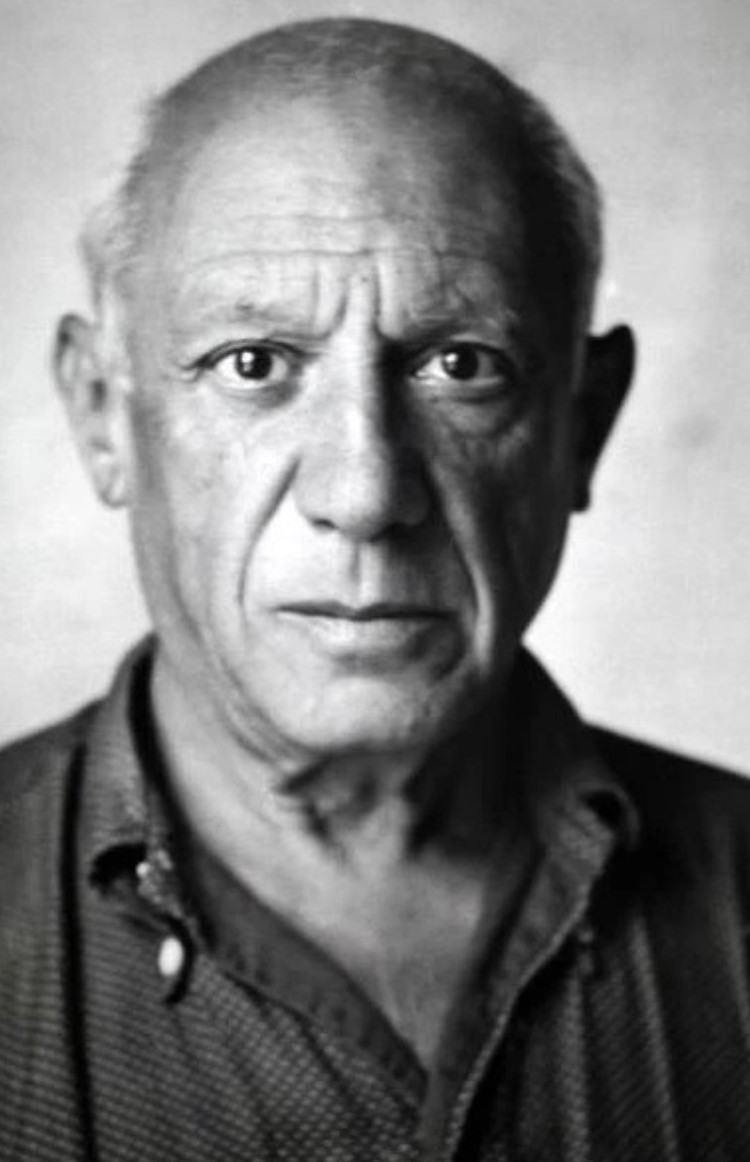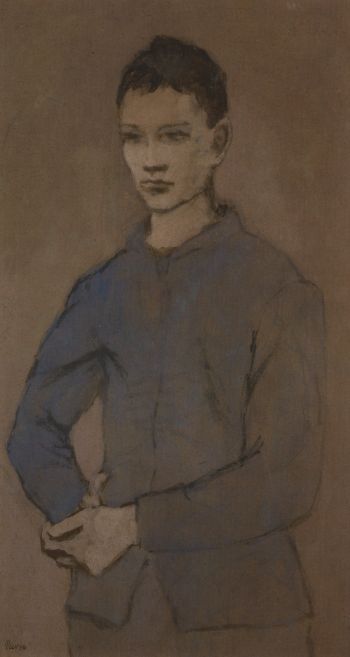
ABOVE: Pablo Picasso. The title of this painting is called: "The Blue Boy" It was created in 1905-1906. Gouache, heightened with watercolor and crayon on board. Size 1000mm by 570mm. Signed lower left: Picasso. Bibliography: C. Zervos. Picasso. Vol. 1, 1932, no. 271. Reproduced in A. Barr. Picasso, 1946 page 40. Provenance: Acquired from the artist by Alfred Fletchtheim, Berlin, in 1910: (1) To Furstin Metchtilde Lichnowsky, Kuchelna, Czechoslovakia, in 1913; (2) New York, Curt Valentine; (3) New York, Mr. and Mrs. Edward M. M. Warburg, by 1931 (4) London Art Market, 1977. Working Description: tall rectangular outlined picture of a male clothed teenage youth with browns and blues with hand on hip. {Gouache is a kind of water-coloring kind of paint, and it is not as heavy as oil-paint. It is sold in tubes and water is added to get the correct viscosity or thinness or wash.}
ABOVE: Pablo Picasso. The title of this painting is called: "The Blue Boy" It was created in 1905-1906. Gouache, heightened with watercolor and crayon on board. Size 1000mm by 570mm. Signed lower left: Picasso. Bibliography: C. Zervos. Picasso. Vol. 1, 1932, no. 271. Reproduced in A. Barr. Picasso, 1946 page 40. Provenance: Acquired from the artist by Alfred Fletchtheim, Berlin, in 1910: (1) To Furstin Metchtilde Lichnowsky, Kuchelna, Czechoslovakia, in 1913; (2) New York, Curt Valentine; (3) New York, Mr. and Mrs. Edward M. M. Warburg, by 1931;(4) London Art Market, 1977. Working Description: tall rectangular outlined picture of a male clothed teenage youth with browns and blues with hand on hip. {Gouache is a kind of water-coloring kind of paint, and it is not as heavy as oil-paint. It is sold in tubes and water is added to get the correct viscosity or thinness or wash.}
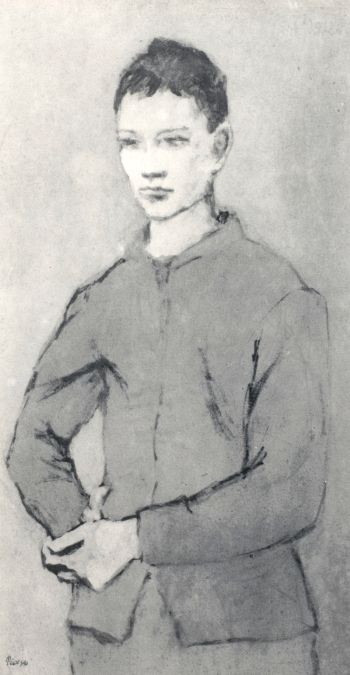
ABOVE A BLACK AND WHITE EXHIBITION X-RAY COPY:Pablo Picasso. The title of this painting is called: "The Blue Boy." It was created in 1905-1906. Gouache, heightened with watercolor and crayon on board. Size 1000mm by 570mm. Signed lower left: Picasso. Bibliography: C. Zervos. Picasso. Vol. 1, 1932, no. 271. Reproduced in A. Barr. Picasso, 1946 page 40. Provenance: Acquired from the artist by Alfred Fletchtheim, Berlin, in 1910: (1) To Furstin Metchtilde Lichnowsky, Kuchelna, Czechoslovakia, in 1913; (2) New York, Curt Valentine; (3) New York, Mr. and Mrs. Edward M. M. Warburg, by 1931;(4)London Art Market, 1977. Working Description: tall rectangular outlined picture of a male clothed teenage youth with browns and blues with hand on hip. {Gouache is a kind of water-coloring kind of paint, and it is not as heavy as oil-paint. It is sold in tubes and water is added to get the correct viscosity or thinness or wash.}
ABOVE: Pablo Picasso. The title of this painting is called: "The Blue Boy" It was created in 1905-1906. Gouache, heightened with watercolor and crayon on board. Size 1000mm by 570mm. Signed lower left: Picasso. Bibliography: C. Zervos. Picasso. Vol. 1, 1932, no. 271. Reproduced in A. Barr. Picasso, 1946 page 40. Provenance: Acquired from the artist by Alfred Fletchtheim, Berlin, in 1910: (1) To Furstin Metchtilde Lichnowsky, Kuchelna, Czechoslovakia, in 1913; (2) New York, Curt Valentine; (3) New York, Mr. and Mrs. Edward M. M. Warburg, by 1931 (4) London Art Market, 1977. Working Description: tall rectangular outlined picture of a male clothed teenage youth with browns and blues with hand on hip. {Gouache is a kind of water-coloring kind of paint, and it is not as heavy as oil-paint. It is sold in tubes and water is added to get the correct viscosity or thinness or wash.}
ABOVE: Pablo Picasso. The title of this painting is called: "The Blue Boy" It was created in 1905-1906. Gouache, heightened with watercolor and crayon on board. Size 1000mm by 570mm. Signed lower left: Picasso. Bibliography: C. Zervos. Picasso. Vol. 1, 1932, no. 271. Reproduced in A. Barr. Picasso, 1946 page 40. Provenance: Acquired from the artist by Alfred Fletchtheim, Berlin, in 1910: (1) To Furstin Metchtilde Lichnowsky, Kuchelna, Czechoslovakia, in 1913; (2) New York, Curt Valentine; (3) New York, Mr. and Mrs. Edward M. M. Warburg, by 1931 (4) London Art Market, 1977. Working Description: tall rectangular outlined picture of a male clothed teenage youth with browns and blues with hand on hip. {Gouache is a kind of water-coloring kind of paint, and it is not as heavy as oil-paint. It is sold in tubes and water is added to get the correct viscosity or thinness or wash.}
|
|
|
THE PICASSO FANZINE NUMBER 7
On this page is Pablo Picasso's painting called "The Blue Boy." It was created in 1906 in Paris, France. It is created from Gouache, {a kind of wash watercolor paint} heightened with crayon on board. The size is 1000mm by 570mm. It is signed lower left: 'Picasso.' Bibliography: this painting is recognized in C. Zervos. Picasso. Vol. 1, 1932, no. 271. The oddness is that this picture in the catalogue is indeed measured in millimeters, namely 1000mm by 57mm = about 40 inches high by 22.5 inches wide.
Before me I have a wonderful book entitled "Impressionist and Post Impressionist Works from a British Collection."
This book is authored by Dewy F. Mosby. It has 143 pages. These are the complete detaills of the books Publication:
The collection of these paintings and etchings was made possible by The Picker Art Gallery, Colgate University, Hamilton, New York and the Archer M. Huntington Art Gallery, The University Of Texas at Austin, Austin, Texas. It was published in 1986 for the March to May 1986 exhibition. Only three thousand of these superb catalogues were printed. The Library Of Congress Card Catalogue Number is 86-06003. And this: "The exhibition and catalogue are made possible through the generosity of the Friends of the Visual Arts at Colgate and the Archer M. Huntington Museum Fund." Text contributors to the Catalogue are Robert McVaugh, Assistant Professor of Fine Arts, Colgate University, and Mary T. Lewis. Visiting Assistant Professor of Fine Arts, Colgate University. Upon opening this catalogue the very first picture we see is the picture presented on this page, and it must be noted that the colors I see are beautiful dark bronzes and dark golds with a chalky pastel blue with roughly hewed black outlines. Beneath this single picture are the words 'Pablo Picasso, Blue Boy, catalogue number 34' but one must turn to pages 96, 97 and 98 of this catalogue for the complete description and insightful commentary by Assistant Professor Robert McVaugh.
THIS IS THE BEGINING OF ORIGINAL CONTRIBUTED REMARKS AND INSIGHTS ABOUT PABLO PICASSO'S BLUE BOY PAINTING.
Giving full academic deference to Professor Robert McVaugh I would like to reproduce a section of his commentary on this particular painting that is found in the above mentioned book. We all surely will benefit from his art-expertise on the Blue Boy painting. The following quotation found on page 98, and Assistant Professor McVaugh says this:
Particularly important to Blue Boy's unsettled stasis is the arrangement of its limbs. The convergence of the youth's hand at his right hip defy anatomical explanation, for the limbs derive not from observation but from Picasso's selective borrowings from his own work. In spite of the obvious similarities to Gainsborough's Blue Boy (c. 1777. San Marino, Henry E. Huntington Art Gallery), the Youth's right arm is a slightly compacted version of that found in the 'juggler with still life'. The enclosed grasp of his left arm and hand (which Picasso originally intended to bring up to the center of the figure's chest) is taken from 'The Young Man Seated' (Daix D. XIII.10), where its cupped hand was explicable as a support for the figure's acutely flexed elbow. In Blue Boy the sitter's left hand is pictorially prominent and decisive to the compositions serene closure at the same time that its anomalous gesture directs attention to the figure's physical disquiet. It accentuates the sense of reverie. Because both physical or narrative explanations for the collision of incompatible gestures are scrupulously avoided, the youth's psychological vitality is mysteriously invigorated. As a result, our comprehension of his figure is slowed and frustrated, in a manner appropriate to Picasso's symbolist ambitions of the Blue and Rose period. (page 98)
Clearly I have read this passage several times, simply because I have had to type it in to the computer. What is to be noticed are these three ideas that (1) Picasso's Blue Boy Picture somehow resonates with Gainsborough's Blue Boy, famously hanging in the Huntington Library located in sunny California, U.S.A., of which I have personally visited. (2) Professor Robert McVaugh's insight saying that Picasso's Blue Boy Portrait is "disquieting" and "the youth's psychological vitality is mysteriously invigorated. As a result, our comprehension of his figure is slowed and frustrated." ( "slowed and frustrated" surely a clever and highly intelligent remark.)This is important to note, especially if we look at the portrait for ourselves. I completely agree with Professor McVaugh. (3) And Professor McVaugh's "explicable" cupped hand remark, I am reluctant to say, is so suggestive that it now looks to me as though the youth is holding a pipe of some kind; and while the matter holds, the suggestion that the youth is wearing one of Picasso's painting-overalls, further edges us, I will argue, into the deeper experiences of Picasso's unsavory sense of reality. But this is later. What is to be done next is to present the absolute standard commentary on the Blue Boy portrait that Professor Robert McVaugh is referring to. On the one hand we do not have a picture of the Blue Boy in the Huntington Library to present in this document. But on the other hand we can present to you what the Metropolitan Museum of Art says about it. The purpose of presenting to you what the Metropolitan Museum of Art says about the Blue Boy painting in the Huntington Library is to justify my own assertions and opinions on Picasso's "Blue Boy" painting that appears on this page.
This said, before me I have a little paperback book with no page numbers on it and it is published by The Metropolitan Museum of Art in 1952. This little book is called: "The Metropolitan Museum of Art: Miniatures. Masterpieces by Hogarth, Constable, Gainsborough, Reynolds, Lawrence, Romney and other English Painters in the Henry E. Huntington Library and Art Gallery, San Marino, California. Text by Theodore Allen Heinrich Curator of Art Collections." On the front page it says: "Your Own Museum Of Art In Miniature," distributer: Book of The Month Club. The Copyright page says this: "New York. Copyright 1952, The Henry E. Huntington Library and Art Gallery. Printed In The United States Of America." In this booklet please go to the Artist called "4. Jonathon Buttall: The Blue Boy....Gainsborough." In brief this book is a small paperback book with 25 pages, each page has a "stamp" sized colored minature picture and beneath it relevant text. It is an old book but the text is highly informative. Let us get on with what is said by the Metropolitan Museum of Art concerning the Blue Boy painting that hangs in the Huntington Library, and I quote:
Johnathon Buttall: The Blue Boy. Gainsborough. Painted about 1770, height 70 Inches.
It is not easy to say anything fresh about one of the most famous and beloved paintings ever painted. The point is that Gainsborough, deliberately challenging Van Dyck on his own ground, has not only achieved with The Blue Boy a pictorial statement of the most sumptuous yet disarmingly simple character but has succeeded in contriving a masterful epitome of the bewildered pride of youth. Jonathon Buttall was the son of a wealthy London ironmonger who had been an Ipswich neighbor of Gainsborough, although the picture was probably painted at Bath. The artist was very fond of the handsome moody boy who was a year or so younger than his own daughters and already fatherless. He, Gainsborough, has dressed him, Jonathon, for the occasion in a costume of the period of Charles 1 (Reynolds also did costume pieces in the style of Holbein and Van Dyck) of the most intense blue, relieved only by touches of white and silver, and has painted the shimmering satin with a virtuosity that apparently dazzled London when the picture was first exhibited in 1770. This bold choice of a difficult principal color later resulted in a legend that the picture was painted to confound an assertion by Reynolds that it couldn't be done; this is untrue-Reynold's warning on the subject was made eight years earlier in the eighth "Discourse". But the {Blue Boy} picture is far more than a bravura showpiece; it is a very penetrating study of adolescence, subtly reinforced at every point by its landscape setting. The Blue Boy is accepted as the Romantic Ideal of Prince Charming, but what stirs us and makes this a painting of enduring force is that the artist has implied a character as complicated and mysterious as that of Hamlet.
End the quotation.
On the one hand we have Professor McVaugh's understanding of Picasso's Blue Boy, and on the other we have the understanding of the Blue Boy by Theodore Allen Heinrich (or for short, Professor Heinrich) the Curator of the Huntington Art collection. But one understanding that is missing, and it is my own. I say this: When we look at the Blue Boy painted by Picasso the first thing to note is that the color scheme is carefully dimmed and it does not in any way dazzle us. This is important to note. Next I say this, the background of Picasso's Blue Boy looks like a dreary bedroom wall and not a wild romantic landscape. We are now seeking the hidden "placement." Try and "place" Picasso's Blue Boy, if you can in a place, a room, or something like that. Next I say this, Picasso's Blue Boy is wearing Picasso's dusty artist-smock and not a sumptuous costume of shimmering satin. Cleverly, and just as cleverly, Picasso casually "costumed" him in his own artist smock, if we can even say this; very curious, and back "placement." Do not forget that Picasso was far cleverer than many of us, and he noticed everything.
But there is general agreement on the moodiness and the "penetrating study of adolescence" that both Professor McVaugh and Heinrich agree on. I say this, Picasso's own penetrating study of adolescence involves the deeper sense of reality. There is a kind of youth-beauty to Picasso's Blue Boy, but it goes further than this, I think it is a picture painted by a painter balancing the reality of the unidyllic youthful life with a paying patrons idolatry of it. Let me explain: and let us say this, and quickly so, Picasso had to sell his paintings to make money and there is no reason to believe this painting was created for a specific wealthy patron that idolized youth. A patron is a patron and a handsome youth is a handsome youth and Picasso sells Picassos. {Thank you, Gertrude Stein.} There is remark: if you gaze at something for too long, then it becomes internalized. Perhaps Picasso is saying, what is idolized is youth in all of its disguises; perhaps Picasso glimpsed the beauty of life in a pouting pipe-smoking bedroomed-eyed boy in the slums of Paris, and sold the idea to a wealthy patron? Perhaps.
My comments on Picasso's Blue Boy will end with this: This painting is worth Millions of Dollars, it is a superb, hypnotic portrait of youth, and captures perfectly our yearning of that kind of eternal youth that for some of us has sadly slipped away. It is true that Picasso was beautiful to look at, and there is more reason to believe Picasso used this natural gift to enhance his own financial and artist career, as well as to attract intelligent money-paying art patrons.
THIS IS THE END OF ORIGINAL CONTRIBUTED REMARKS AND INSIGHTS.
PICASSO FANZINE.
|